

Scoring in Stereo
When two teammates move in harmony, it becomes a swan song for the opposition.


Welcome back to Between the Sidelines. It’s Wednesday, which means one thing: we’re diving into another corner of the NBA.
Today, my New York Knicks host the visiting Oklahoma City Thunder, and the seats and court of Madison Square Garden will be graced with a new theme day: Best Friends Night.
Naturally, that got me thinking about camaraderie and perfect chemistry. About the kind of partnership that reduces defenses to a bundle of nerves before tip-off.
Have you ever seen a duo move in perfect sync? Their steps almost rhythmic as they dance up and down the court, passing, lobbing, and slamming down dunks. The pair of teammates you don’t want your team to face, because your defense wouldn’t be able to mute the sound of the net snapping over, and over, and over.
Today, we’re talking exactly about these collaborations, and highlighting three of the top scoring tandems in the league right now.
A quick note on my parameters: I started with the 50 highest individual points-per-game (PPG) averages in the league and identified duos from that group. For thoroughness, I then cross-referenced those names with the top 50 total point scorers to see if my initial pairings showed up consistently. (They did, and you’ll see the pairs and runner-ups below.)
(Editor’s Note: All statistics are current as of 8 p.m. ET on Tuesday, March 3, and do not include that evening’s games.)
Now, quickly, before you read any further, guess the three duos we’re spotlighting and keep them in mind.
Okay.
Ready?
Let’s face the music.
Philadelphia’s Tyrese Maxey (29.0 PPG) & Joel Embiid (26.6 PPG)
The data backs it up: when this pair is healthy and available, they’re one of the most elite scoring duos. And not just in the East, but in the league.
By the numbers, they’re the earliest-appearing teammates on the list of players with the highest points-per-game averages this season.
Tyrese Maxey is in the midst of what many are calling a true breakout campaign. He leads the league in total points scored (1,711), minutes played (2,258.0 total; 38.3 per game), and field goals made (596). He’s also second in total three-pointers made (197), and tied for fourth overall in scoring average at 29.0 PPG.
Joel Embiid, meanwhile, continues to prove what we already know: when he’s healthy, he makes an impact. Despite appearing in just 33 games, which is the second fewest among the top 15 players in PPG (ahead of only Giannis Antetokounmpo at 30 games) Embiid still ranks 13th in the league in scoring average at 26.6 PPG.
Early in the season, the question on every pundit’s mind wasn’t about individual production. It was about fit and chemistry, and how this 76ers offense would look when everyone was healthy and ready to go.
Let’s get into the numbers I’ve pulled only from the games where both players were available.
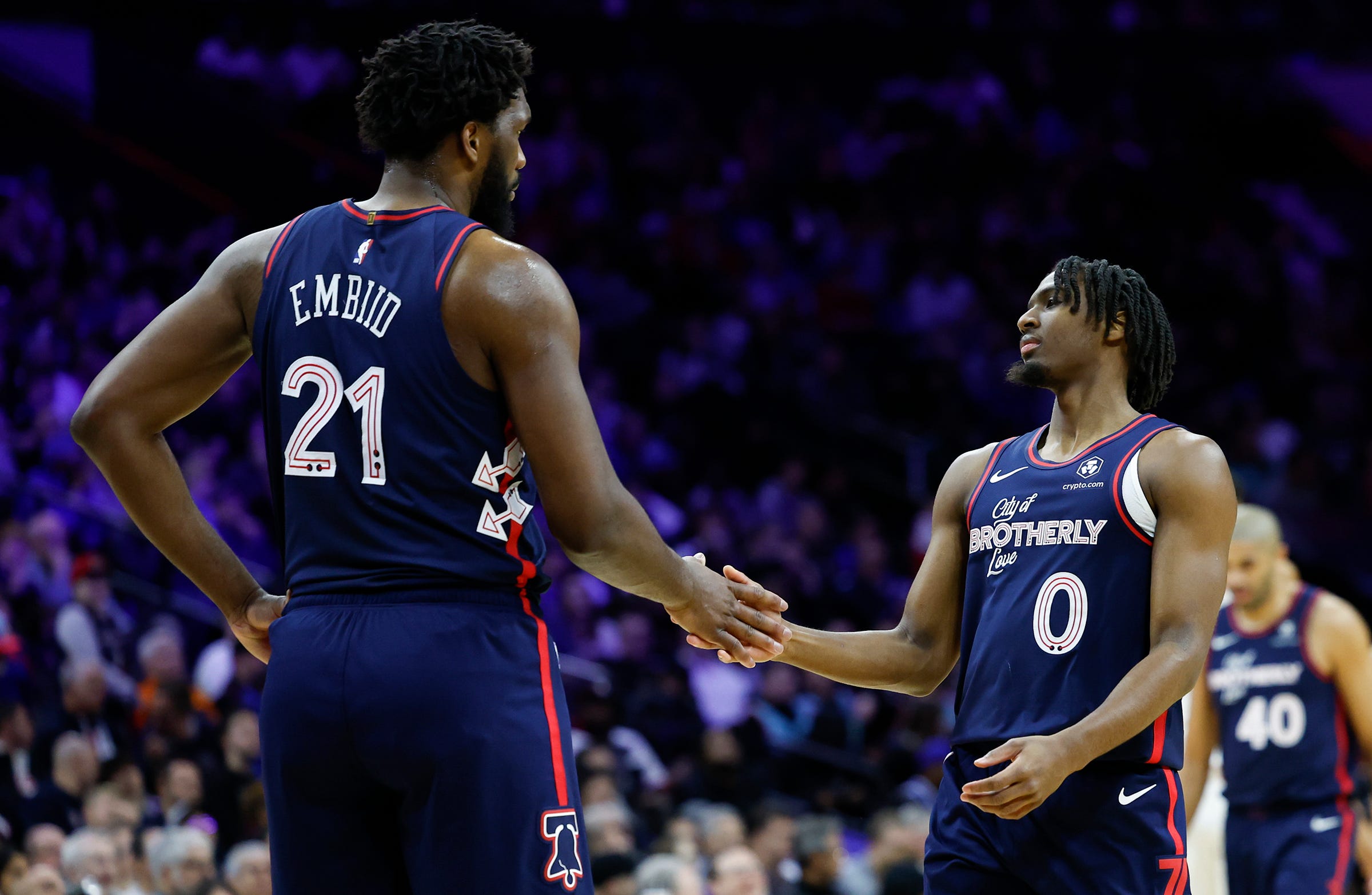
Maxey and Embiid have shared approximately 838 total minutes on the court this season, which is about 26.7 minutes per game across 31 contests.
Maxey’s per-game numbers tick up slightly in those games where Embiid is active alongside him. He averages 29.5 points (up from 29.1 on the season), 7.4 assists (6.8 overall), and 4.6 rebounds (4.1 overall).
When both are on the floor, the 76ers post a +6.7 team Net Rating, with a 123.1 Offensive Rating and a 116.4 Defensive Rating.
And for comparison, when both players are off the floor, the team’s Net Rating drops to -1.77. The Offensive Rating settles at 114.4, while the Defensive Rating is a 116.2.
So, what can we infer from this?
The offensive jump is significant when Embiid and Maxey share the court, with nearly a +8.7 increase in points per 100 possessions compared to when both players are sitting.
And let’s put that further into context: an elite offense typically posts a Team Offensive Rating of 120 or higher. Together, Embiid and Maxey power the 76ers to a 123.1 mark, which firmly places them in top-tier territory.
Similarly, the team’s overall Net Rating leaps from -1.77 to a +6.7. That is a huge swing of 8.47 points, and signals that the Maxey-Embiid pairing meaningfully changes the team’s overall performance on the court.
The defensive numbers remain relatively steady, with little fluctuation either way. That just means that the Maxey and Embiid pairing does not impact the defensive rhythm but substantially elevates the offense.
One recent example of the pair’s combined offensive dominance came against the Indiana Pacers, where Embiid scored 27 and Maxey 32 in a 135-114 victory. Here’s a snippet of an article that detailed the duo’s performance:
“When Embiid was in the game, the Sixers used him as the fulcrum. With the ball in either his or Maxey’s hands, Embiid either bumped defenders on DHOs and led Maxey to the rim with a bounce pass ahead or spaced out of screens and waited for Maxey [...] As mentioned above, Embiid enhanced Maxey’s shot quality.”
Or take January 29, when the 76ers faced the Sacramento Kings: Embiid and Maxey combined for 77 points (accounting for 68% of Philadelphia’s 113 total) marking the 15th time the duo has each scored 30 or more in a regular-season game.
And those 15 games are not only huge, but nearly flirting with franchise history. Only Wilt Chamberlain and Hal Greer (16) have recorded more 30-point games as a duo in a Sixers uniform than Embiid and Maxey.
The data makes the case for this duo’s top-tier impact.
The only question left is whether the team’s health will cooperate long enough for us to see their full ceiling come playoff time.
We’ll find out in April.
Denver’s Nikola Jokić (28.7 PPG) and Jamal Murray (25.7 PPG)
The 2026 NBA Regular Season has often required Jamal Murray to step into a larger leadership role for Denver’s offense during Nikola Jokić’s absences—and he’s done so with absolute poise and ease in a career-high campaign for Murray to date. But in the 44 games where the two teammates have shared the floor, the results have been nothing short of astronomical.
And when I say that, I mean it wholeheartedly.
Let’s get into the numbers.
Murray currently ranks 15th in the league in points per game (25.7) and ninth in total points (1,463). As I mentioned earlier, this is the best season of his career by the numbers. Despite a reputation for slow starts, often cited as a reason he’s missed out on past All-Star nods, this year has just looked different. He opened strong, and when Jokić was sidelined with injuries, Murray steadied the offense. Not only that, but across the board, he’s converting more field goals, free throws, and three-pointers than ever before.
As for Jokić, even with time missed that may push him to the fringes of the MVP race, his production remains elite. He’s averaging 28.7 points per game (the second-highest mark of his career behind last season’s 29.6), 10.1 field goals made per game, and 1.9 three-pointers per game. He’s also getting to the line and converting at a higher clip than normal.
So, doesn’t it only make sense that this all combines for a pairing that is top tier offensively?
Of course it does.
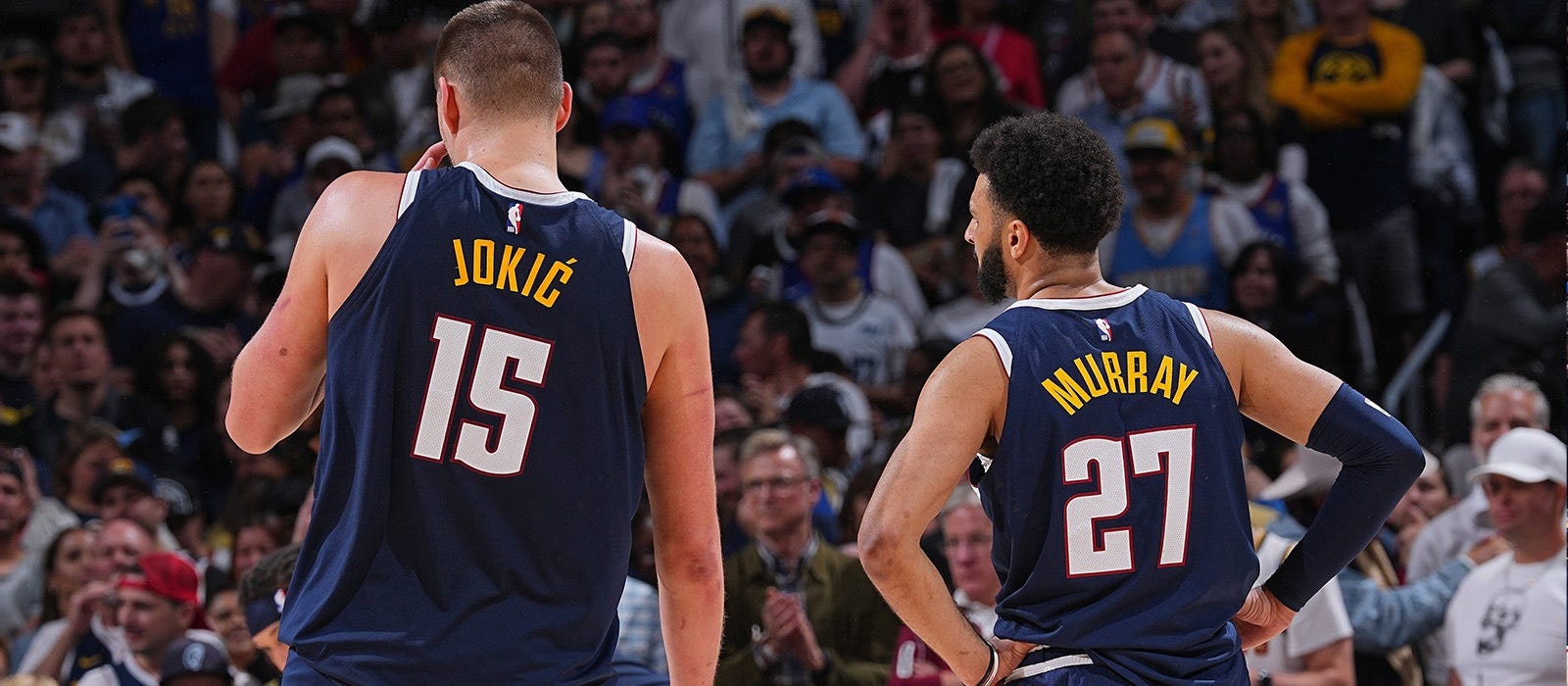
When Murray and Jokić are on the floor, Denver’s Offensive Rating is out of this world: a staggering 129.6.
(And this checks out, because Denver’s overall team Offensive Rating is first in the league, with a 120.3.)
Additionally, the team’s Defensive Rating when both are on the floor is 117.7 and the overall Net Rating is a whopping +12.0.
Now compare that to when both are off the floor: the Offensive Rating drops to a 109.9, their Defensive Rating sits at 116.3, and Denver’s Net Rating is a drastically sobering -6.4.
The swing alone from -6.4 without Jokić and Murray to +12.0 with them paints the picture.
What I found even more interesting, though, is what happens to Denver’s Offensive Rating when only one of the duo plays. With Murray on/Jokić off, the Offensive Rating holds steady at 119.7, and with Jokić on/Murray off, it’s 117.8. This illustrates that even when separated, they anchor a high-level offense.
So, to wrap up, what are our takeaways from these statistics revolving around Murray and Jokić? There’s three key points to remember:
They’re two superstars in the middle of incredible individual seasons, combining to form one of the league’s most elite offensive pairings. Denver leading the league in Offensive Rating is the baseline for this, but the 129.6 mark with both on the floor is the exclamation point.
The drop-off without them is steep. A Net Rating swing from +12.0 to -6.4 and an Offensive Rating fall from 129.6 to 109.9 makes one thing crystal clear: their absence is felt overwhelmingly on the offensive end.
The Murray and Jokić situation really mirrors the earlier Maxey and Embiid example. The defensive metrics for the 76ers and Denver sit still either way, but it’s on the offensive end where the dramatic swing occurs when their duos are on the floor.
And lastly, each superstar can independently maintain the elite levels of production on the offensive front.
Where does this leave Denver, though?
Well, according to this article, with one of the toughest remaining schedules left in the league.
But, this remains true, and is a bright spot for Denver as they look to make a true run up to table for higher seeding:
“Even if the Nuggets’ gauntlet of opponents in the next six weeks might be more formidable than that of the other teams, they still have one of the league’s best duos. And if Jokic and Jamal Murray are at the top of their game, they are hard to beat.”
Read that one more time.
If this superstar pairing is at the top of their game, who, exactly, is stopping them?
Lakers’ Luka Dončić (32.4 PPG) and Austin Reaves (23.8 PPG)
Do we all collectively remember when Austin Reaves had the most insane and explosive start to his fifth season with the Lakers, with some games without teammates Luka Dončić and LeBron James. Was that a fever dream?
No, it was very real.
Through the first five games of the NBA Regular Season, Reaves averaged an astonishing 34.2 points, 10 assists, and 5.6 rebounds per game, while shooting roughly 37% from three. He recorded a career-high 51 points against the Sacramento Kings, and then did what? Followed it up with 41 against the Portland Trail Blazers!
In both of those outings, he single-handedly led the Lakers’ offense with Dončić out temporarily and James not returning until November.
The NBA even highlighted the historic nature of Austin’s run, which made him only the “3rd player EVER to record 170+ PTS & 50+ AST through the first 5 games. 7th player EVER to tally 25+ PTS & 5+ AST in each of the first 5 games of a season and the only Laker to do so since Jerry West in 1970-71.”
After that blistering start, many of us wondered if Dončić’s return would impact Reaves’ production.
So, also no, that didn’t really happen.
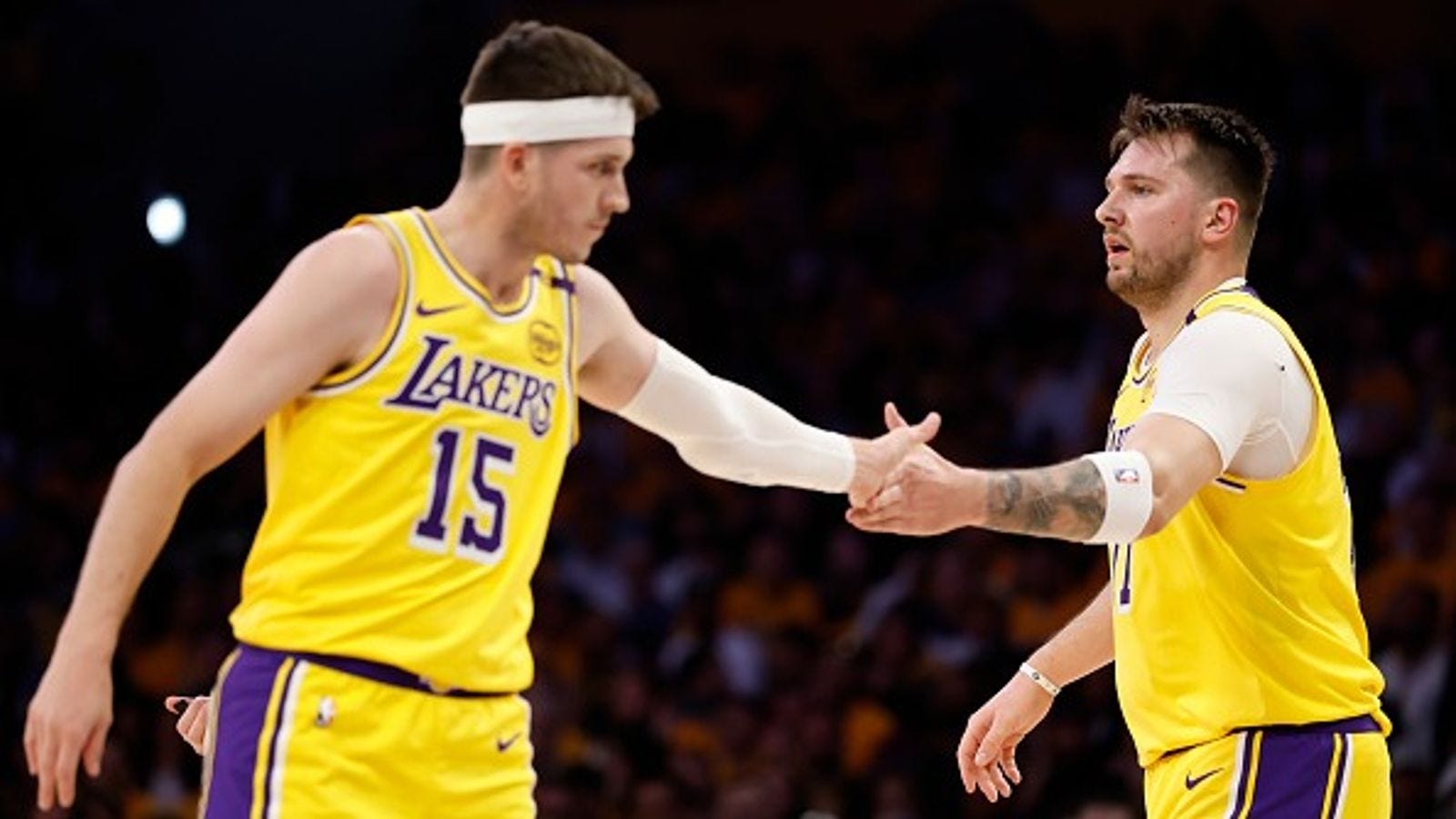
In the games they’ve played together, the numbers around medium/high leverage possessions tell us the following:
With both Dončić and Reaves on the floor, the Lakers post a 122.3 Offensive Rating, a 111.4 Defensive Rating, and a strong +10.9 Net Rating.
When both are off the court, the offense dips to 112.1 the Defensive Rating freezes at 114.6, and the Net Rating shrinks to a marginal -2.4.
To avoid repetition from further sections, let’s simply highlight what this means: Dončić and Reaves on the court make a tangible impact. An eight-point swing in Net Rating and a significant Offensive Rating jump reflect real on-court chemistry and value, and not just box-score padding.
Here’s the issue. Like Philadelphia’s pairing where Embiid has missed some time out, availability plays a huge role in Reaves and his story this season too.
Reaves has only played 35 games this season despite his scintillating start, sitting out due to a lingering calf injury. At one point, he missed 19 straight games before returning to come off the bench. Still, his season average points per game is 23.8, which is good for the 23rd best in the league.
Luka, on the other hand, is leading the league in scoring at 32.4 points per game and ranks third in total points with 1,586.
And to understand just how explosive this pairing was early on, here’s a glimpse of what ESPN was saying at the time:
“Doncic’s and Reaves’ combined scoring average of 61.4 points per game is the second-most by a duo in the last 60 years, according to ESPN Insights. James Harden and Russell Westbrook combined for 61.6 points per game in 2019-20.”
They were seriously good.
Now, the duo has the potential to evolve into an elite trio with teammate and legend LeBron James.
But, as we all know, potential is one thing. The chemistry on the floor has to be there, and with time ticking down and the Lakers sitting in sixth place, it’ll have to develop quickly if this team wants a shot in the playoffs.
The full story of this Lakers trio might deserve a piece of its own come the end of the season.
Let’s put a pin in it.
Honorable Mentions
This piece very quickly turned into an in-depth dive on the three specific duos mentioned. But honestly, there are several other pairings across the league that deserve at least a spotlight for what they’re doing together on the floor!
(Editor’s Note: If anyone is interested in these duos having an expanded analysis, I could do that as well! Consider this an open invitation to let me know in the comments if any of these pairings and their numbers pique your interest.)
And the pairings are..
Donovan Mitchell & James Harden (CLE)
On Court: 132.1 Offensive Rating | 120.8 Defensive Rating | +11.2 Net Rating
Off Court: 112.8 Offensive Rating | 114.2 Defensive Rating | –1.4 Net Rating
Jalen Brunson & Karl-Anthony Towns (NYK)
On Court: 122.8 Offensive Rating | 115.2 Defensive Rating | +7.6 Net Rating
Off Court: 99.7 Offensive Rating | 99.0 Defensive Rating | +0.7 Net Rating
Anthony Edwards & Julius Randle (MIN):
On Court: 121.5 Offensive Rating | 115.8 Defensive Rating | +5.7 Net Rating
Off Court: 107.2 Offensive Rating | 100.1 Defensive Rating | +7.1 Net Rating
So, what have we learned from all of these examples?
Well, two things:
Availability is crucial. Yes, some of these numbers are loud, but they only get to be if the players that make these ratings up are actually available to be on the court together.
The offensive lift is significant for most of these duos. The defensive impact tends to be steadier, subtler, and more so dependent on the players they share the court with.
Of all the duos mentioned here, which one stands out to you the most? Which pairing would you trust in a playoff series?
Let me know in the comments.
Until next Wednesday, see you between the sidelines.
Such a wonderful read!! Helping with the conversion to the NBA!
Really good article. I’m interested in an article about the Laker trio. LeBron is my guy, and the fact he is still so good at his age is mind boggling to me. It would be cool if you looked at past duos. I remember watching LeBron and D-Wade growing up and that was some chemistry there.